


Zootopia 2: Starting Brave Conversations
Discover how Zootopia 2 can spark meaningful classroom discussions on discrimination, inclusion, and civic courage, with teaching ideas and resources.
Cartoon Image Credit: MyShell Art's Zootopia Filter - "See Yourself as a Zootopia Character in Seconds"
Share
December 19, 2025
Discover how Zootopia 2 can spark meaningful classroom discussions on discrimination, inclusion, and civic courage, with teaching ideas and resources.
Share
My son and his friends use the word ‘twin” to show their respect for a shared interest or to compliment each other. It’s the 17-year-old equivalent of me writing “same” to my group chat. I’ve always loved these little connections, times when we acknowledge our shared humanity. I also loved when everyone in the theater was saying, “Hey Barbie!” My all-time favorite movie to teach though, is Zootopia, so my expectations were low with the sequel; however, I am thrilled that Zootopia 2 picks up right where the first left off—both in chronological time and ideology. As Judy Hopps, the bunny protagonist of Zootopia 2 says, “The world will never be a better place if no one is brave enough to do the right thing.” I can imagine Amanda Gorman, the youngest presidential inaugural poet, responding with, “For there is always light/ if only we’re brave enough to see it /If only we’re brave enough to be it.” Kind of a “twin” moment, and a “Hey Barbie!” moment rolled into one. I’ll have to wait until it comes out on streaming, but when it does, I will definitely do a timestamped lesson for you, like the one in my book The Flexible SEL Classroom and found in this blog. There’s so much to unpack, just like the original, but the movie’s approach to inclusion and representation is a great reason to head to the theater this holiday season.
No spoilers, but the origin story of Zootopia isn’t honorable, and upon the centennial anniversary, the duo of Judy Hopps and Nick Wilde, now official partners with the Zootopia Police Department, are on the case. At the center of the controversy is Gary De’Snake, who believes that Milton, the patriarch of the Lynxley family who positions himself and his family as the town’s founders and creator of the climate-controlled atmosphere. The Lynxley family perpetuated lies about snakes, making everyone fear them, causing Zootopians to cling ever more tightly to their mammal-only city.
It’s an easy leap to see the connection between Zootopia’s revisionist beginnings and that of the United States, as well as the “othering” of non-mammals. Not only is this narrative not true, but it erases the contribution of the female leader, Agnes Lynxley. Will the 10 and under crowd recognize these themes? I’m not sure, but the American Psychological Association’s article, “Talking to Kids About Discrimination,” implores families to, “Take opportunities to raise discussions based on what you see around you—in real life, books, television shows and even video games.” You might ask: “There aren’t many female characters in this video game. What do you think of that?” or “Do you think that show accurately portrays LGBTQIA+ characters, or does it rely on stereotypes?” (Zootopia 2 has the first gay couple in a Disney film, Bucky and Pronk Oryx-Antlerson) Zootopia 2, like the original, touches on so many discriminatory themes that I made this handy little chart to connect to resources that pair nicely.
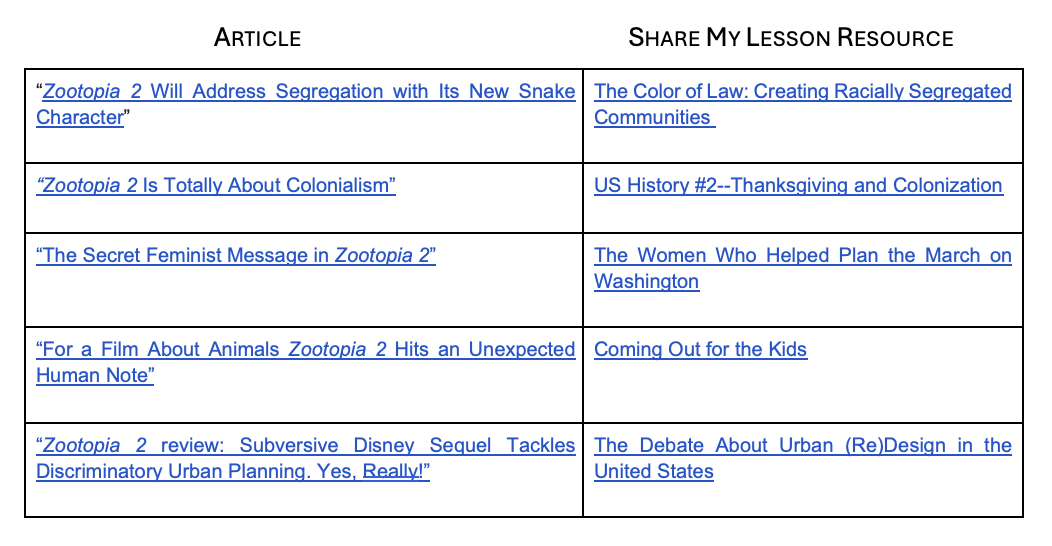
As I built this table, it occurred to me how much deeper a high school class could go into these issues than I can go with eighth-graders. The articles and resources could be used for debate, research, or a reading jigsaw. The important part is that the conversation is happening in schools with caring adults guiding students to be part of a respectful community. I just scratched the surface here of great tie-ins to the movie, articles, and Share My Lesson resources, so if you dig into teaching Zootopia 2, share your discoveries with me. Circling back to Judy Hopps and Amanda Gorman: We must be brave enough to have these conversations.
We've curated a collection of racial literacy resources designed specifically for educational settings. These resources, ranging from lesson plans to free professional development webinars, are selected to not only deepen understanding but also to empower students to engage in meaningful discussions about race and antiracism.
Want to see more stories like this one? Subscribe to the SML e-newsletter!